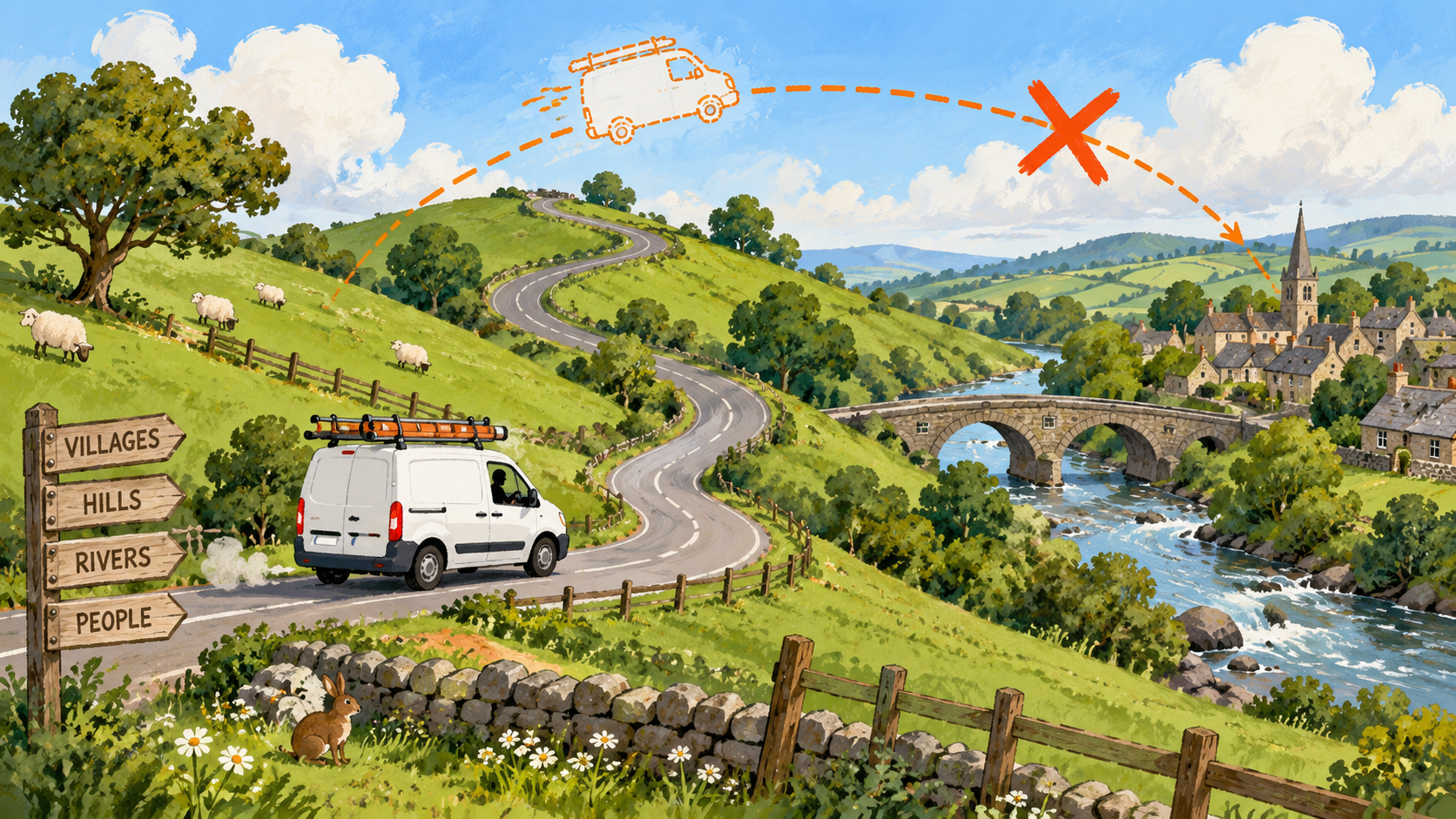
Let's begin with the van.
It has tyres. It has a driver. It does not have a portal, whatever the targeting map appears to believe.
Draw a beautiful circle around a service business and you will include places that are easy to reach, places that are a nuisance, and at least one place where the journey takes so long that everyone involved will hate lunch.
A radius is a convenient shape. It is not a business plan.
I once tried discussing a local offer with nothing but a map on the screen. The person who actually did the visits immediately started adding reality: that route is slow, that area works when jobs can be grouped, that address would need a different arrangement.
Five minutes of conversation made my perfect circle look rather silly.
Good. The circle needed it.
There is a temptation to advertise to the largest plausible area because somebody might be willing to travel for a good job. Maybe they are. Ask them. Do not convert “we occasionally go there” into “we provide the same service everywhere inside this border.”
The customer does not know your internal exception list. They see an invitation and reasonably assume it applies.
Then they ring and explain the problem, describe the address, perhaps take time off to arrange a visit, and discover that the actual answer is more complicated.
Now the business has an unsuitable enquiry, the customer has wasted time, and the campaign has another cheerful conversion. Marvellous.
Ask the person with the keys
I want to know which places the business normally serves, where a different condition applies, and which jobs can justify a longer journey. I want to know whether the website explains those distinctions and whether the receiving team can answer the obvious question.
A postcode check may help. A list of areas may help. Plain copy may be enough. The answer depends on how the service is arranged.
What doesn't help is making the customer guess whether “local” means ten minutes away, the whole region or wherever the van happens to finish its previous appointment.
The campaign boundaries also need reviewing when the business changes. A new person, a different starting point or an altered schedule can change what is workable. The map isn't a tattoo; you can update it.
But update the offer as well. If an outer area has a longer wait or a different visit arrangement, the page should explain it before the enquiry becomes a negotiation.
Here is the part people call negative
Some visitors should be told early that this is not the service for their location.
There. I said it. A departure can be a useful result.
We spend so much time treating every person who leaves as a leak that we forget a website can save somebody a pointless phone call. If you genuinely cannot do the work, clarity is a kindness and an operational improvement.
That doesn't mean putting a grumpy warning banner on everything. It means giving a suitable customer enough information to recognise themselves and an unsuitable one enough information to look elsewhere.
Read the enquiries with the receiving team. Which areas fit? Which ones create a long explanation? Where does the page keep making a promise the schedule can't support?
Those details will tell you more than admiring the map.
I like local advertising precisely because the reality is hard to ignore. Somewhere an actual person has to get in the van.
The campaign should probably make that person's day possible.

A thought worth keeping?